Viking Range Repair
Up the Slot: Moving a 48-Inch Viking Into a Five Points Townhome With a Drive Aisle, No Elevator and the Kitchen on
Written by
Owen Castellanos
Service technician — doors, hinges and cabinet work · 12 years in the trade
A 48-inch Viking reaches a Five Points slot-home kitchen up a switchback stair, not an elevator, so measure the landing before the delivery is booked — the faults a rough move causes surface weeks later as ignition and simmer complaints.
The part of the year that matters
Winter is the season that decides a Denver range delivery, and the building form that decides it is the slot home. Denver City Council adopted the Slot Home Text Amendment (Bill 18-0306) on 7 May 2018, effective 10 May 2018, ending a form that had spread through Five Points: dwellings turned perpendicular to the street behind a shared drive aisle, garages beneath, living space stacked above.
The amendment stopped new ones going up. It did nothing about the decade of them already standing, and those are now ordinary for-sale stock in Five Points and the blocks around it. What that means for a 48-inch appliance is simple to state and rarely stated: no elevator, no kerb to unload against, and a kitchen at the top of a switchback stair above the garage.
That last part is an inference from the built form rather than something the ordinance says, and it deserves to be read that way. It is also an inference you can check in ten seconds by standing at the bottom of your own stair with a tape. Between November and March, add ice on the aisle and on any exterior tread, and a move that would merely be awkward in June turns into a real decision about whether to attempt it that week at all.
What the swing asks of the machine
Swing is the word that governs this job — the arc a crated range has to turn on a stair landing without contacting two walls at once. If the crate cannot make that turn, the appliance goes up bare: on its back, on its side, or walked up on edge. Almost everything later blamed on the range starts there.
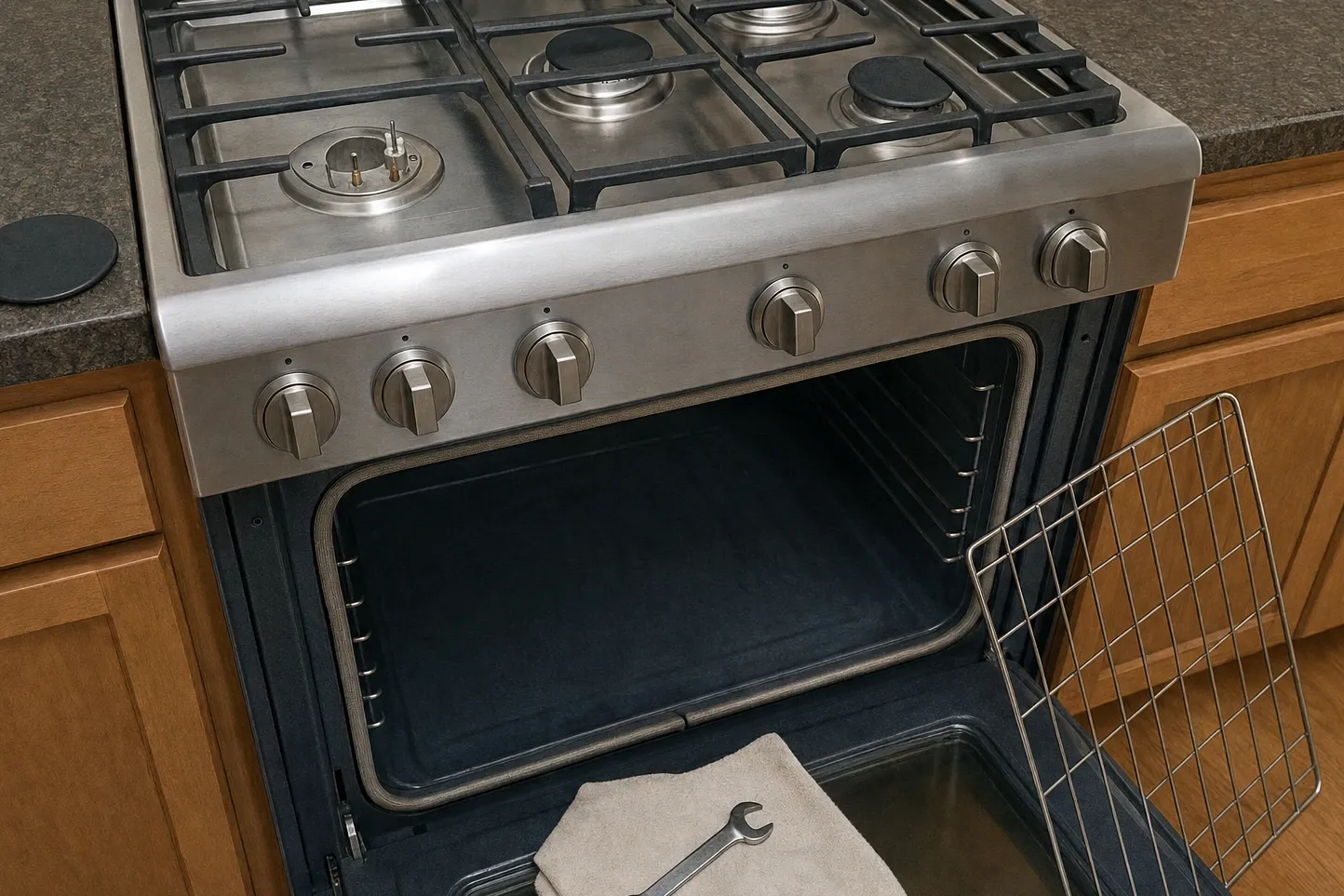
An uncrated professional range loses its grates, its burner caps and often its doors so the crew can get hands on the body. Legs come off. The gas manifold, the igniter harness and the oven door hinges all take load nobody designed them to take. Then the range is set down in a narrow kitchen, pushed into the cabinet run, and never levelled, because levelling is the last five minutes of a job that has already run two hours long.
The alternative form in this service area fails differently rather than less. Golden Triangle sits in a D-GT zone district that allows construction up to 30 stories, at around 11,800 persons per square mile (2022 US Census Bureau, via DenverUrbanism), in buildings such as the 16-storey Belvedere Tower, completed in 2000 with 79 condominium units, or the 18-storey Prado Condos, completed in 2002 with 108. There the appliance travels a padded service elevator on the building’s calendar instead of a stair on yours. Virginia Village and Belcaro largely escape the problem: a fifties brick ranch on a wide lot takes an appliance in through a back door on the level.
The failure it produces, and when
Move-related faults surface in the first few weeks, not on the first evening. One burner sparking over and over without catching, a low setting that keeps blowing itself out, a knob that turns freely while the flame barely changes — those are the fingerprints of parts disturbed in transit, not of a range that has worn out.
The chain is mechanical throughout. An electrode knocked out of its gap throws its spark to the wrong place. A burner cap lifted off for the stair and dropped back on crooked sits proud of its ports and will not carry flame around the ring. A strained valve stem gives you knob travel without modulation. A gas connection flexed during the lift can leave the manifold marginal, and at the burner that reads as a flame standing tall and orange, sooting the bottoms of pans.
Elevation belongs in the same conversation. A Viking that arrives in a Denver kitchen still set up the way it left the showroom floor may need its burner setup revisited for altitude, and a range that has just been hauled up a stair rarely gets that check either. Two separate problems land on the same week and get reported as one.
Getting ahead of it
Measure the route, not the opening. Whether a 48-inch range fits the cabinet run is a five-minute question with a tape. Whether the crate turns your stair is the hour-long one, and it is the one nobody asks. Measure the narrowest tread, the landing depth at the switchback, the door swing at the top and the headroom under the soffit.
Then plan the parts of the day nobody plans. Where does a truck stand in a shared drive aisle without blocking four neighbours? Can the crate be broken down outside, and can the appliance be kept out of the weather while that happens? Are the treads being covered? And the item forgotten every single time: how does the old range come back down that same stair, in reverse, with an appliance nobody is being careful with any more.
Photograph the stair from the bottom, from the top and at the landing before you book anything. In a Golden Triangle tower the equivalent homework is the building’s own rules and calendar; in a Five Points slot home it is a tape measure and three photographs.
What we do on the visit
We work a recently moved range in the order that separates transit damage from a component that has genuinely failed. Level and seating first, then spark at each electrode with its ground, then gas at the manifold, then the valve, and only then the control electronics. That sequence is what stops sound parts being replaced on suspicion.
Igniter or burner assembly work runs $170 to $470. Oven thermostat or heating element work is $210 to $420. A control board or touch panel is $420 to $610. Where the house runs a full Viking suite, as Belcaro kitchens often do, refrigeration fan or defrost system work is $270 to $650, dishwasher pump or control work $210 to $370, and compressor or sealed-system repair $1,370 to $3,240. Anything we fit is a factory-approved part.
A diagnosis costs $89, and what it buys is a named component instead of a guess about one. Call (720) 704-2791 or use the booking link to put a visit on the calendar.
Follow-ups
Will a 48-inch Viking range make it up a Five Points slot-home stair?
Often, though not always in its crate. Measure the narrowest tread, the depth of the switchback landing, the door swing at the top and the headroom under the soffit, then compare those against the crate rather than the appliance. If the crate will not turn, the range travels bare, and that is when grates, doors, legs and the gas connection take load they were never intended to carry.
My Viking started playing up a few weeks after we moved it upstairs. Is that a coincidence?
Rarely. Transit damage tends to be quiet at first. A displaced electrode, a burner cap dropped back on crooked, a strained valve stem or a flexed gas connection all present as ignition and simmer complaints over the following weeks rather than on day one. Mention the move when you book. It changes the order in which the fault is worked, and it usually shortens the visit.
Does a Golden Triangle high-rise need different planning from a townhome delivery?
Yes, and the constraint shifts from a tape measure to a calendar. In towers of the Belvedere or Prado type — 16 and 18 storeys, 79 and 108 units respectively — the appliance travels a reserved, padded service elevator on the building's schedule. In a slot home nothing is reserved and nothing is padded, so the limits are the stair itself and the weather on the day.