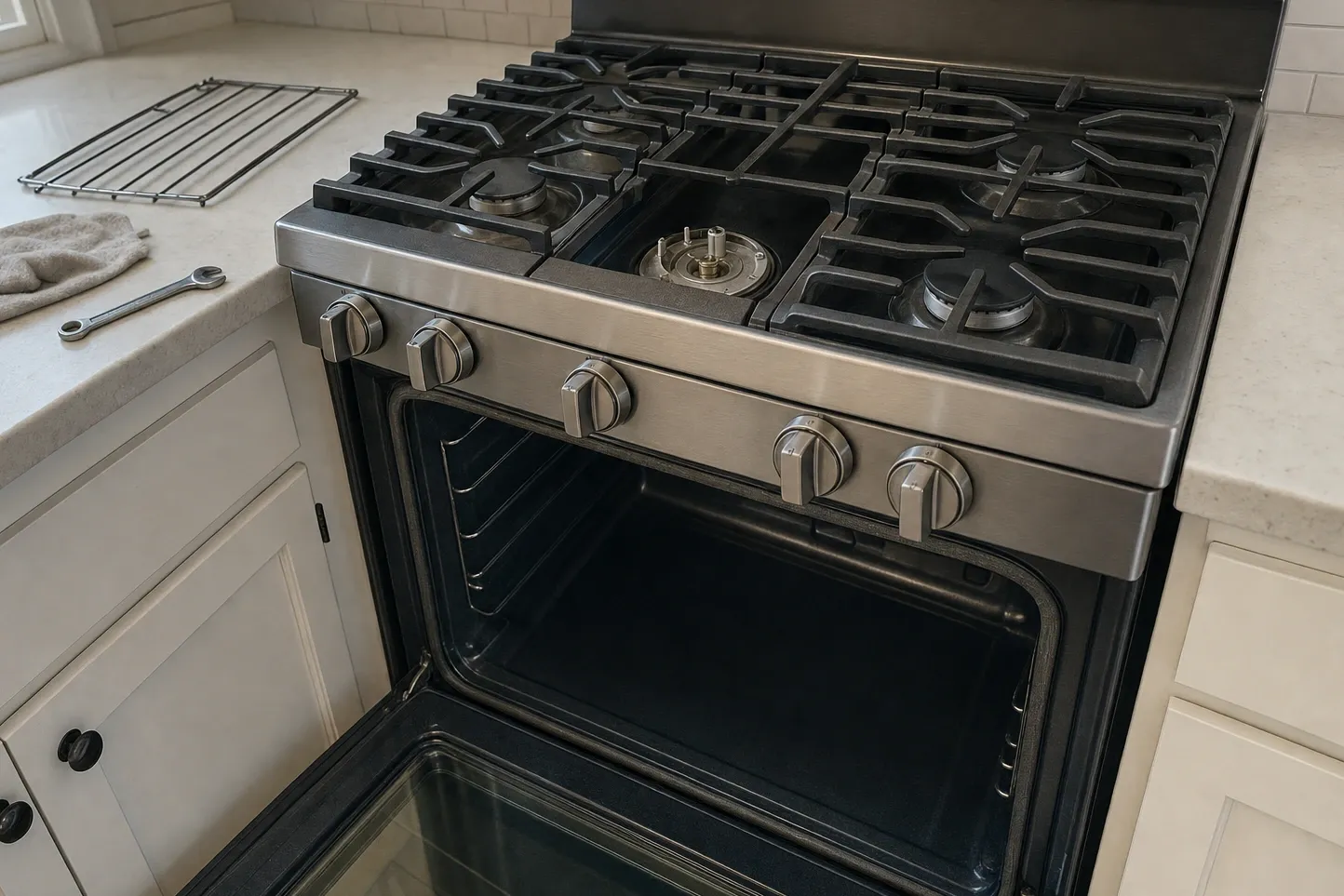
- 1 igniter
- 2 burner base
- 3 burner cap, set aside
- 4 burner grate
In this frame: burner base with the igniter standing clear.
Clifford Nakamura
- Certified
- EPA 608 certified
- Bench
- Service technician — controls and intermittent faults
- Trade
- 22 years in the trade
Repair or replace · 01 of 6
Igniters Failing One After Another: Repair or Replace?
A second and a third igniter on the same rangetop.
Igniters are consumable in the way brake pads are consumable: they wear, and one day they stop. What they are not is serially unlucky. When the same rangetop takes a second and then a third, something is shortening their lives, and fitting a fourth without finding it buys you the same few months again.
What actually shortens an igniter’s life
Viking’s own troubleshooting is unusually direct about this. Against a burner whose igniter keeps sparking after the flame is already lit — the commonest warning sign before an outright failure — it lists three causes and stops: the power supply is not grounded, the power supply polarity is reversed, and the igniter is wet or dirty.
Two of those three are the wall, not the range. An ungrounded or reversed supply leaves the spark hunting for a path to earth, and it will find one, through the ceramic if it has to. The ceramic cracks, the spark starts jumping to the burner base instead of across its gap, and the burner clicks bravely and lights nothing. Fit a new igniter into that same outlet and you have bought a new consumable, not a repair.
The third cause is the one owners can see. A boil-over that runs down into the burner base leaves sugar and starch baked against the ceramic, and that deposit holds moisture for weeks. Viking asks for the caps to be taken off and cleaned after every spill-over for exactly this reason, and warns against putting them through a dishwasher or a self-clean cycle, which rusts them instead.
The mechanical cause nobody looks for
A burner head has two tabs underneath that locate it on the outside edge of the base, and Viking is specific that those tabs must not line up with the igniter. Get the head a notch out and the cap no longer sits level; the spark gap is wrong from the first day, the igniter works harder than it was built to, and the flame is uneven into the bargain. It is a thirty-second correction that nobody makes because nobody looks, and it is worth ruling out before a part is ordered.
When the answer would flip to replace
It flips when the burner base itself is the casualty rather than the igniter — a base that has been arced into repeatedly, or one corroded enough that a head will not seat square on it any more. At that point the job is the assembly rather than the electrode, which is a different band, and it is worth asking how many of the other burners are heading the same way. One is a repair. Four at once, on a rangetop that has already had two other faults paid for, is the point where the arithmetic on this page stops favouring the repair.
What the visit looks like
The meter goes on the receptacle first, because that is the cheapest thing to be wrong and the most expensive thing to miss. Then each igniter in turn: dry, whole, square in its bracket, sparking to the base rather than round it. Ports get cleared with a pin where they need it, never opened out and never with a toothpick. Caps and heads go back seated flat with the arrows to the back, and every burner is lit and run down to its lowest step before anyone leaves.
Before you decide anything
- Keep the igniters that failed if you still have them. A crack in the white ceramic means the spark was going to earth somewhere it was never meant to go.
- Lift each cap while the range is cold and check it is sitting flat, with the arrow on the burner head pointing to the back of the range.
- Count which burners the failures happened on. All on one burner points at that burner; scattered across the rangetop points at the supply feeding all of them.
- Think back to boil-overs. Sugar and starch bake onto a ceramic igniter and hold damp against it long after the rangetop looks clean again.
A third igniter on the same rangetop is a diagnosis waiting to happen, not a budget line. Ring Viking Repair Service Denver on (720) 704-2791 and we will put a meter on the supply before anyone sells you a fourth.