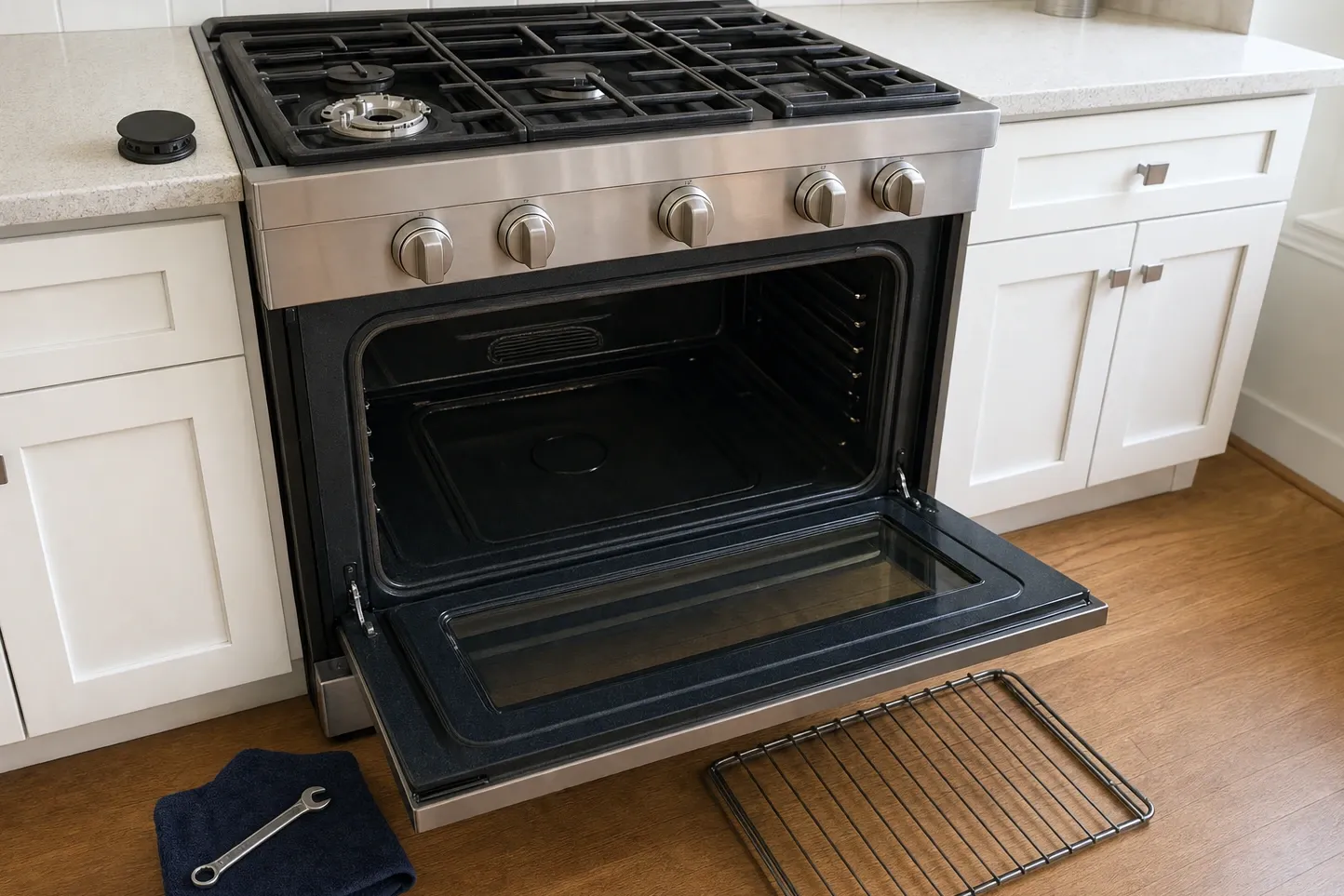
- 1 burner base, cap lifted off
- 2 burner cap, on the worktop
- 3 cabinet run beside the range
- 4 oven door, dropped fully open
In this frame: wide range in shaker cabinetry, burner opened.
Clifford Nakamura
- Certified
- EPA 608 certified
- Bench
- Service technician — controls and intermittent faults
- Trade
- 22 years in the trade
Repair or replace · 06 of 6
Remodelling the Kitchen: Keep the Viking Range or Not?
What to have looked at while the drawings can still be changed.
A remodel is where perfectly good Viking rangetops get thrown away. Not because anybody examined one and found it wanting, but because it is the appliance nobody thought to check and the easiest line in a quote to say yes to. The decision gets made by a drawing rather than by the machine.
Why the look belongs before the order
Once the cabinets are on order, keeping the range has become a constraint instead of a choice. The opening is drawn, the run is set, and finding out in week six that the burners want attention is an interruption rather than a decision. Ahead of that, the same visit is information: a sound range stays in the plan and stops being an expense, and one with something wrong gets a part and a band named while that still changes what you order.
It is worth saying which way we lean, because it is the opposite of everybody else in the room at that stage. We would rather you kept it. A cooking surface that works is the one appliance in the room that already knows how to do its job.
What we go over
Each burner lit, taken up and brought down to its lowest setting, and watched there rather than glanced at. Caps and heads lifted off, checked for pitting and for ports that have closed, and refitted the way the manufacturer sets out: tabs to the outer edge of the base, clear of the igniter, cap level, arrow to the back. Igniters looked at while everything is apart, because that is when it is free to do. And the model and serial read off the label under the control panel, so anything the range does need can be checked against what is still made for it.
What we will not tell you
Anything about the kitchen around it. We do not size openings, we do not advise on clearances or extraction, we do not touch gas runs, and we do not install appliances — those belong with your designer and a gas fitter, and we would be guessing. Viking’s own position is that adjustments or conversions between natural gas and LP need a certified technician; it is not a detail to fold into a build by hand. Take what we find about the machine and hand it to the people doing the room.
The two ways it ends
Either the range goes back into the plan with nothing owing, and the visit has bought you the confidence to spend the money somewhere it shows. Or it has something wrong, you get the part named and the band it falls in, and you decide with a real number in front of you instead of a salesperson’s shrug. Both of those are worth the call-out, and one of them is worth a great deal more than the call-out.
Before you decide anything
- Book the look before the cabinet drawings are signed, not after the units are delivered. The answer is only worth having while it can still change something.
- Have the range cold and clear on the day. Caps and heads come off by hand and go back the same way, and a warm rangetop stops that before it starts.
- Write down what has quietly annoyed you about it over the years. A simmer that never really held is worth more to us than a tidy worktop.
A kitchen budget should not be carrying a range nobody has actually looked at. Ring Viking Repair Service Denver on (720) 704-2791 and have it gone over while the plan can still move.