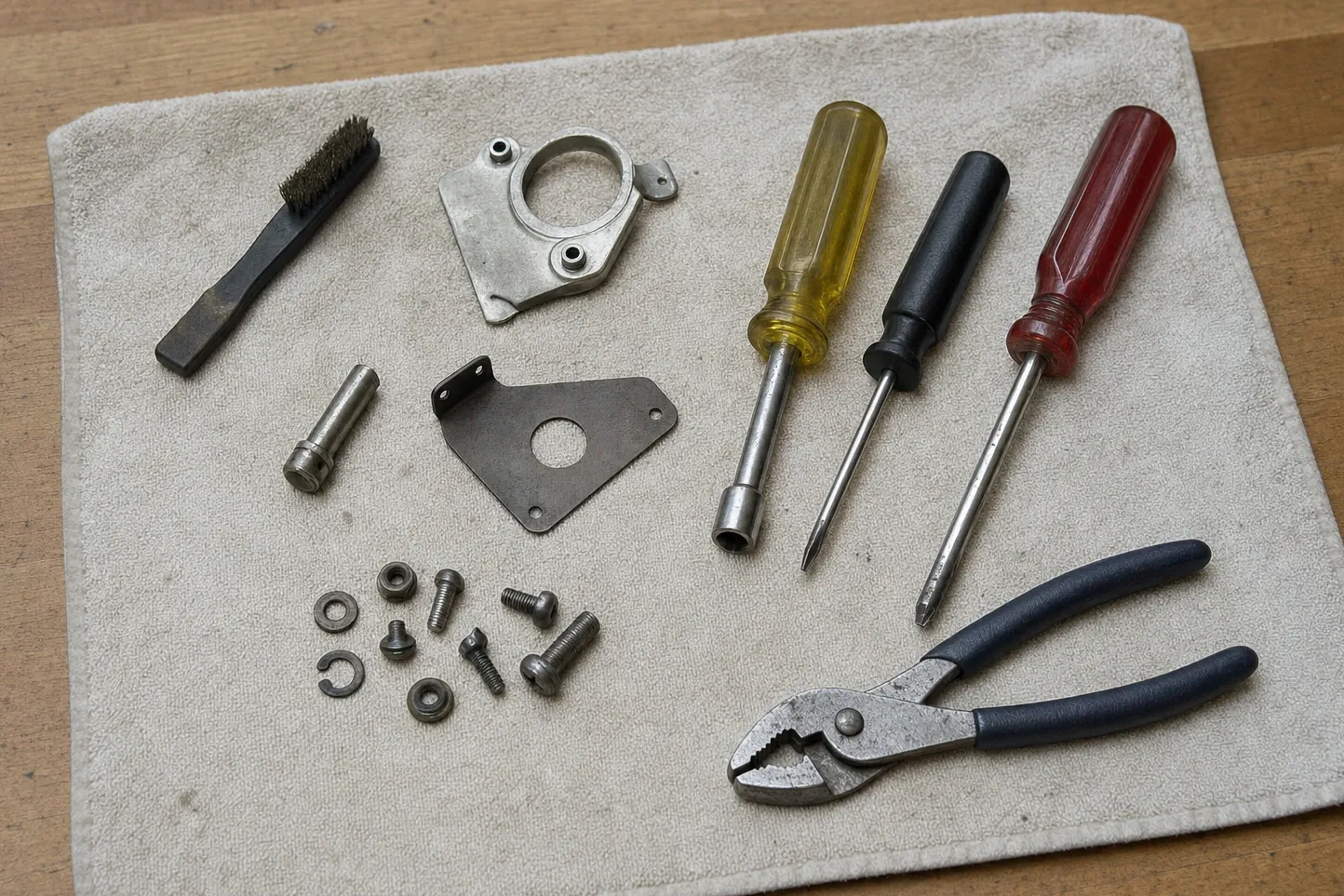
- 1 cast collar, two bolt bosses
- 2 steel bracket, centre hole
- 3 short steel sleeve
- 4 circlip, nuts and washers
In this frame: cast collar, steel bracket, sleeve and fixings.
Clifford Nakamura
- Certified
- EPA 608 certified
- Bench
- Service technician — controls and intermittent faults
- Trade
- 22 years in the trade
Repair or replace · 02 of 6
An Older Viking Range: Can It Still Be Repaired?
Age is not the obstacle. A part nobody makes any more is.
An older Viking rangetop tends to arrive in the conversation already half condemned. Somebody has said it has had its day, or a parts counter went quiet on the phone, and the kitchen is being priced. We hold that open until two things are settled: what the machine actually is, and whether the one piece it wants can still be bought.
Where the answer starts
At the label, and on these ranges it is not hidden. Open the oven door, look up under the control panel, and the model and serial are printed there. Three Series units carry theirs under the front edge of the same panel. On a Seven Series the rangetop has a label of its own in that position, so a rangetop and the range below it are never assumed to be one vintage. On the older professional ranges a duplicate is fixed to the back of the machine, which is what rescues the job when the front one has been scrubbed illegible.
Viking’s own service pages in the guide ask for those two numbers, the purchase date and the dealer’s name before anything else, and we work the same way round. A photograph of that label turns the parts question from an argument into a lookup.
What does not finish a range
Wear does not. Caps pit, ports close up, igniters give out, knob printing goes. Those are pieces the manufacturer expects to be taken off by hand and renewed, and it prints the strip-down in the owner’s own guide rather than keeping it back for a technician. A rangetop that has been apart before is not compromised either; it is one somebody bothered with. None of that is a reason to buy a new machine.
What does
One thing: a piece that is no longer made, with nothing that goes in its place. That is established, not sensed. We take the model and serial, identify the part against them, and find out whether it can be had. Either it can, and there is a repair with a band around it, or it cannot, and there is no repair at any number at all. We will not tell you something is unobtainable because the last one was awkward, and we will not say a piece is waiting on a shelf before we have seen that it is.
Where the part exists we fit genuine Viking parts. The manufacturer’s own instruction is that a repair uses authorised parts, and on a machine that has been in one kitchen a long time it is also the surest way of having the piece seat the way the original did.
Either way, you hear it first
The parts answer comes before the order, never after it. If the piece is there, you get one number from inside its band and the work starts when you agree to it. If it is not, you get that sentence plainly, the visit has still bought a real answer, and nobody spends a month waiting on something that was never coming.
Before you decide anything
- Open the oven door and look up under the control panel. The model and serial are printed there, and a phone photograph of them tells us more than any account of the fault.
- Keep anything that has already been changed on the range. A previous repair narrows the search, and the piece itself often carries its own number cast into it.
- Count how many separate things have gone wrong so far. One awkward burner is a part. Four unrelated faults on one machine is a different conversation entirely.
Nobody should be quoted for a part that cannot be got. Send the model and serial to Viking Repair Service Denver on (720) 704-2791 and the parts question is answered before a technician is booked.